
What 2,147 Registrations From 149 Countries Tell Us About the Reach of Global Virtual Events
We talk a lot about the ability of global virtual events to reach an international audience. But what does “global” actually look like?
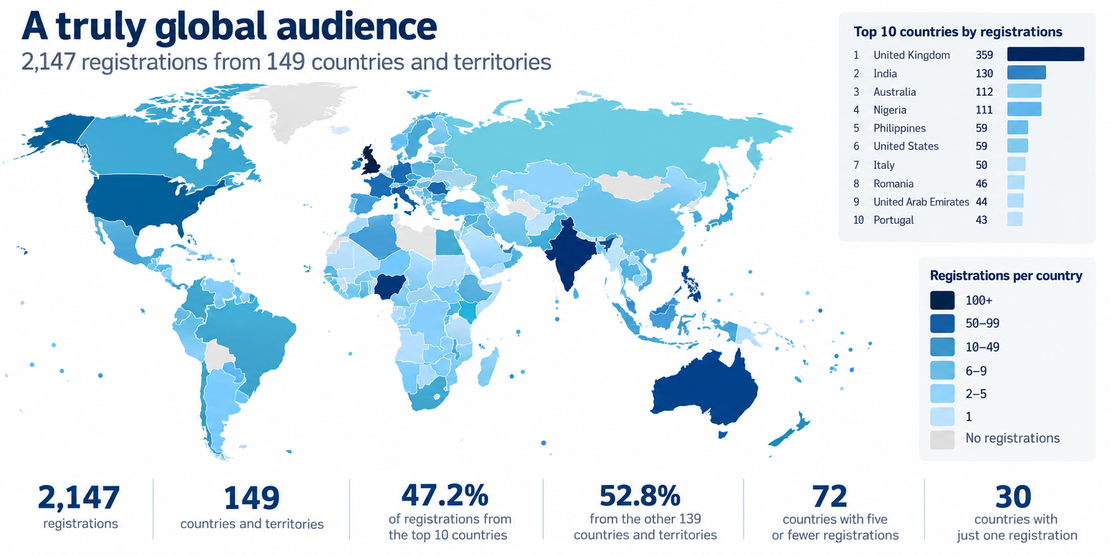
In September 2026, BeThere Global produced a webinar for one of our key clients which attracted 2,147 registrations from 149 countries and territories.
The overall number is impressive. But it was the geographical spread behind it that caught our attention.
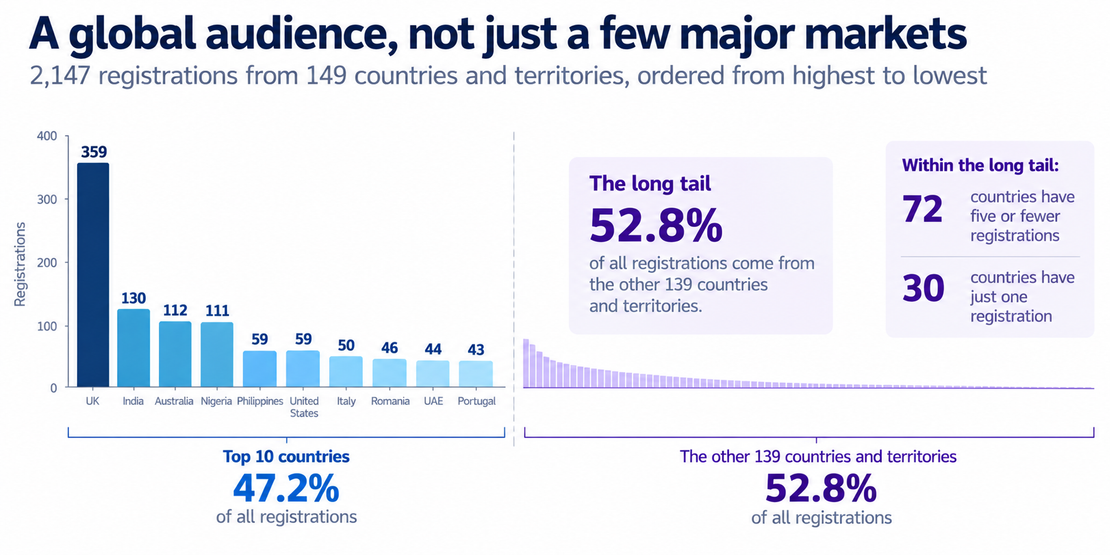
There were, as you might expect, some substantial concentrations. The UK accounted for 359 registrations, followed by India with 130, Australia with 112 and Nigeria with 111. The Philippines and United States each accounted for 59 registrations, with significant audiences also coming from Italy, Romania, the UAE and Portugal.
But those larger numbers tell only part of the story.
What the registration data showed
Across the webinar:
- 2,147 people registered
- Registrations came from 149 countries and territories
- 83.3% of registrations came from outside the UK
- The ten countries with the most registrations accounted for only 47.2% of the total
- Another 139 countries and territories accounted for more than half of all registrations
- 72 countries and territories had five registrations or fewer
- 30 countries and territories were represented by a single registration
| Measure | Result |
|---|---|
| Total registrations | 2,147 |
| Countries and territories represented | 149 |
| Registrations from outside the UK | 83.3% |
| Share from top 10 countries | 47.2% |
| Countries/territories with five registrations or fewer | 72 |
| Countries/territories represented by one registration | 30 |
Registration figures don’t tell us exactly who eventually attended, how long they stayed or how actively they engaged with the programme. What they do show very clearly is the geographical demand for the event and the potential international audience made accessible through virtual delivery.
More than half the audience sits outside the top ten
Take the ten countries with the most registrations and, between them, they account for just 47.2% of the total.
That means more than half of the webinar’s entire registered audience came from everywhere else, spread across another 139 countries and territories.
That is quite a different picture from an international event where a handful of major markets dominate the audience.
Keep travelling down the registration list and it becomes more interesting still.
There are 72 countries and territories with five or fewer registrations. Thirty are represented by just one person.
One person in Afghanistan.
One in Fiji.
One in Mongolia.
One in Papua New Guinea.
One in South Sudan.
In purely statistical terms, those are tiny numbers.
In terms of reach, they may be some of the most interesting numbers on the spreadsheet.
What does one registration mean?
It’s very easy when looking at event analytics to concentrate on the biggest figures.
But imagine trying to assemble this same audience physically.
Bringing together hundreds of people from the UK alongside 130 from India, 112 from Australia and 111 from Nigeria would already make for an exceptionally international event.
Then add participants from well over a hundred other countries, including places represented by only one or two people.
The practical and financial barriers to creating that audience in one physical location would be considerable. For many of those individuals, attending simply wouldn’t be realistic.
With a virtual event, somebody joining from a country represented by a single registration can potentially have access to exactly the same speakers, presentations and discussions as somebody joining from a country represented by hundreds.
That is where the long tail becomes important.
Audience size and global reach aren’t the same thing
We sometimes use scale and reach almost interchangeably when talking about virtual events, but they measure different things.
An event could attract several thousand registrations and still draw the overwhelming majority of its audience from one country or region.
Conversely, a smaller event could have extraordinary geographical reach.
For this webinar, 83.3% of registrations came from outside the UK.
But even that figure doesn’t quite capture the diversity of the audience.
The more revealing number is 149.
It tells us that the content found an audience not only in the obvious large markets, but across an extraordinarily broad geographical footprint.
And the fact that more than half of all registrations came from outside the ten largest participating countries shows just how distributed that potential audience really was.
Making specialist knowledge accessible
For organisations whose purpose includes education, professional development or sharing specialist knowledge internationally, that matters.
The value of international virtual events isn’t simply that more people can attend.
It is that people can take part from places where assembling a viable local audience, or travelling to a physical event, may never have been practical.
Someone who would never justify the cost of an international flight, several nights in a hotel and time away from work can still access the same specialist knowledge as somebody based much closer to the event organiser.
That can be particularly important for professional associations, medical organisations, membership bodies, universities and other organisations whose communities are naturally dispersed around the world.
Virtual delivery doesn’t remove every barrier to participation.
Time zones, language, internet connectivity and local working patterns still matter.
But it can remove geography as one of the biggest.
What this means for organisations running global virtual events
There is also a practical lesson here for anybody planning an international webinar, conference or online event.
If a substantial proportion of your audience sits outside your largest markets, the event needs to be designed for that audience from the beginning.
Time zones become important. So does making recordings available quickly after the live event. Depending on the audience, captions, translation or multilingual content may improve accessibility considerably.
Technical decisions matter too. An event platform that works perfectly for somebody sitting in a London office needs to perform just as reliably for somebody joining thousands of miles away, possibly on a very different internet connection.
It is also worth looking beyond headline registration and attendance figures when measuring success.
Knowing that 2,147 people registered is useful.
Knowing where they came from, which regions attended live, how long they stayed, which sessions they watched and whether they returned to recordings afterwards tells you considerably more.
That’s why we tend to think about event analytics as part of the event itself rather than something you glance at afterwards.
Our guide to measuring the success of virtual events looks at some of those measures in more detail.
Registration isn’t the same as attendance
There is an important caveat in all of this.
Registration doesn’t automatically equal attendance or engagement.
Some people register and don’t attend. Others join only part of an event. Some watch the recording later.
That is why we wouldn’t claim that 2,147 registrations automatically means an audience of 2,147 active participants.
What the data does demonstrate is international interest and potential reach.
Attendance data, viewing time, engagement, session participation and on-demand viewing can then help build a fuller picture of what happened after registration.
For organisations serious about understanding their audience, both sets of information matter.
Why this kind of reach matters
At BeThere Global, we spend much of our time thinking about the technology, production and logistics required to make virtual and hybrid events work.
Platforms.
Streaming.
Speaker management.
Registration.
Technical support.
Event recordings.
Analytics.
Sometimes, though, a simple spreadsheet provides a useful reminder of why all that work matters.
This one contains 2,147 registrations.
The number we’re more interested in is 149 countries and territories.
Because scale is one thing.
Reach is another.
Frequently Asked Questions
How global can a virtual event be?
A virtual event can potentially attract participants from almost anywhere with suitable internet access.
This event, produced by BeThere Global in September 2026, generated 2,147 registrations from 149 countries and territories, with 83.3% of registrations coming from outside the UK.
What is the difference between virtual event scale and reach?
Scale describes the overall size of an audience, while geographical reach describes how widely that audience is distributed. A global virtual event could attract thousands of people from a small number of countries, while another might attract a smaller audience spread across dozens or even more than a hundred countries.
How should the reach of a global virtual event be measured?
Registration data can show where interest in an event originates, but it should ideally be considered alongside attendance, viewing time, engagement, session participation and on-demand usage. Together, those figures provide a much more useful picture of how successfully an event reached and engaged an international audience.
About the data
The figures in this article are based on registration data from a webinar produced by BeThere Global in September 2026.
The client has not been identified for confidentiality reasons.
The dataset contained 2,147 registrations from 149 countries and territories. These figures represent registrations rather than confirmed live attendance, so they should be interpreted as evidence of geographical interest and potential audience reach.


